4.28.2004

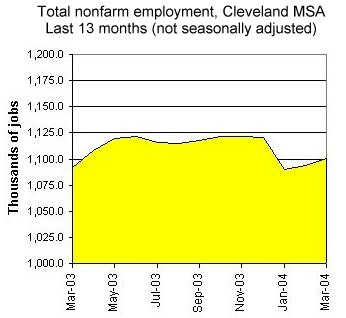
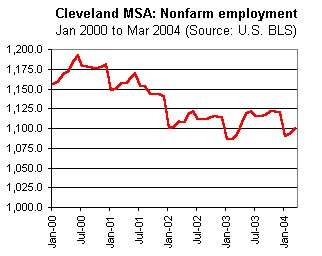
CLEVELAND METRO AREA "GAINED" 6,000 JOBS IN MARCH: The Bureau of Labor Statistics released their metropolitan area employment numbers for March this morning, as promised. The Cleveland-Lorain-Elyria MSA shows 1,100,500 nonfarm jobs for March compared to 1,094,200 in February and 1,090,300 in January. Good news, right? Except that the March number is 20,000 jobs lower than the figures for October, November, and December, as well as last May and June.


These numbers are not seasonally adjusted, and Cleveland seems to have an annual first-quarter slump, so it may be too early to see anything important here. Over the last full year (March 2003 to March 2004) the BLS shows a metro job gain of 8,600 -- about .8%. If this continues, we may see local employment through the Summer and Fall that's slightly higher than 2003 and 2002, but still 20-25,000 jobs below the 2001 level. Look at the Summer peaks in this longer-term line:


So is this a "recovery"? I guess it depends on whether you're one of the lucky 8,000, or the unlucky 20,000.

4.27.2004

THERMA-GONE?

I really, really hope I'm wrong about this. From all reports, Carol Latham has been a spectacular entrepreneur, a model employer and good citizen of her neighborhood. Maybe she really believes that her company can continue to prosper on Detroit Avenue as a small division of its new multinational owner. Maybe she's right.

But...

Here we have a $15 million-a-year patent-driven family-owned startup, with less than a hundred employees, being bought by a multinational with 4,500 employees spread around dozens of facilities in ten countries, with annual sales between $700 and $800 million. The new owner, Laird Group, has already bought two other thermal-product companies in the last seven months to add to its Laird Technologies division, which makes a wide range of components for circuit board manufacturers -- Thermagon's main market. The biggest, fastest-growing piece of that market is in Asia. In the last four years Laird has closed plants and laid off workers in the U.S. and Britain, while making major investments in production capacity in China, Korea and Japan.

So how long will Latham get to run Laird's "thermal materials business worldwide" and produce Thermagon's products -- mostly for export to China and other faraway circuit-board centers -- from that rehabbed building at West 47th and Detroit, with her "special culture" of neighborhood workers? And what happens when she retires?

Thermagon, our spunky inner-city tech startup with a heart of gold, has been one of Cleveland's favorite business stories for years. But it turns out we've only been reading the first chapter. Now it's Chapter 2, the entrepreneur has cashed out, the spunky startup is suddenly part of a big global machine, and the characters and plot become a lot more complicated.

Will this still be a Cleveland story? Will it end happily for Thermagon's West Side workers and neighbors? Will the Laird Group keep the dream alive on Detroit?

I sure hope so. But so far, this neighborhood hasn't seen a lot of happy endings.
NEW CITY COUNCIL WEBSITE: Some time in the very recent past Cleveland City Council put up a new version of its website, and it's a big improvement... still pretty basic, but much user-friendlier than the old one. My favorite new features: the ward finder and the searchable City Charter and Ordinances.

Also, for those obsessing about the "regionalism issue", they've posted the full text of Council President Frank Jackson's City Club speech last Friday.

4.26.2004

MARYBETH TALKS SENSE, AS USUAL:

What a lot of people seem to forget is that not every voter forms an opinion about the Cleveland schools from what is reported in the media. Many Clevelander's opinions are developed by what they observe in the community...

If the schools want to get community support, then they need to reach out to the community.

...If every school sent delegates to the neighborhood block clubs and business associations, and became proactive in opening communications, rather than waiting for volunteers to come to the school, it would be so much easier for the voting public to get to know all the good things that are going on in the individual buildings.


In politics, as in education, as in life, relationships are everything. If teachers in Cleveland public schools were the neighborhood leaders they could be, both the schools and the neighborhoods might work a lot better.

Go get em, MB.

4.24.2004

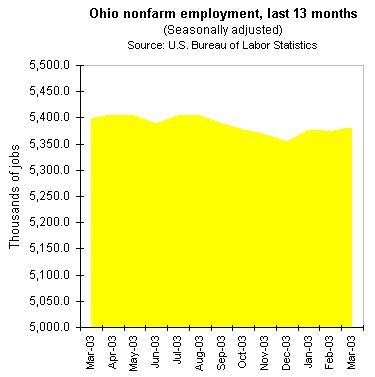
OHIO GAINED 8,000 JOBS IN MARCH... leaving the state 17,000 jobs down compared to a year ago.

The U.S. Labor Department released state-by-state March employment statistics yesterday. Here's "Table 5. Employees on nonfarm payrolls by state and selected industry division, seasonally adjusted". Ohio's numbers: 5,381,400 jobs in March compared to 5,373,500 in February, 5,378,600 in January, and 5,398,100 in March 2003.


You gotta look pretty hard to see a recovery in that picture.

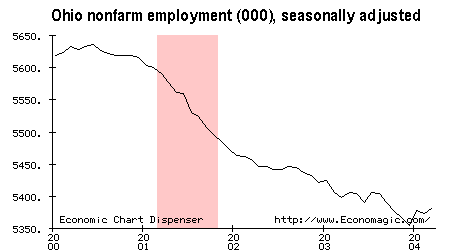
For the longer view of Ohio's recent experience, here's a chart generated by the incredible Economagic site. The pink area is the official national recession, which started in March 2001 and "ended" the following November.


The metro area numbers are supposed to be released Wednesday. For the story on greater Cleveland, stay tuned.

THE PORT OF OHIO: Why worry about regionalism? department:

I took an hour off and went to the Cleveland-Cuyahoga County Port Authority board meeting yesterday. The idea was to learn more about the Ontario ferry project, which I did and will report about later. But I also learned that the Port's economic development bond financing has taken some interesting turns.

The board approved two financing packages yesterday. One was for a manufacturer in Eastlake, which, you may recall, is in Lake County. The other was for a shopping center project in Parma Heights, in which there's another partner -- the Port of Toledo.

It seems that the Ports of Cleveland and Toledo have an understanding that they can call each other in to help sweeten deals. This was Toledo's second investment in Cuyahoga County. Cleveland hasn't put up any bucks for Lucas County yet... but a couple of years ago, both Ports went in together with the State to help finance a food processing plant in Chillicothe.

And you think we have no public officials with regional vision!

This was all explained to the board yesterday by Cleveland Port Director Gary Failor, who just coincidentally used to have the same job in Toledo, where he developed the whole port-bonds-for-other-development-projects thing. Interestingly, some board members seemed to have no idea this has been going on.

4.21.2004

MORON MEDIA: Channel 5 gets to the important stuff...

Byrd-Bennett said she will give up her upcoming raise and bonus, some of which she has given to charity in the past, NewsChannel5 reported.

She added, however, that if questions persist about her salary instead of the $100 million budget deficit, she will take action.

"If it is the pleasure of this board and this mayor, I have absolutely no problem in returning my entire salary because my contract is up at the end of December. That way, you will have the opportunity to find a leader for your school district," she said.


Be sure to check out the accompanying poll.

So in less than one news cycle, we've gone from "How to deal with the deficit" to "Should BBB work for free and then leave?"

Aaaaaarghhh!
MORE PUBLIC EDUCATION, PLEASE: Cleveland schools CEO Barbara Byrd-Bennett went to the last two School Board meetings with presentations about large budget cuts to eliminate a projected $100 million deficit for the year starting July 1. At last night's meeting she laid out her layoff scenario, which includes over 600 teachers and about 300 other employees. Here's the Plain Dealer coverage of that meeting.

In preparation for this announcement, the district put letters in all their teachers' mailboxes yesterday. It was no surprise, since talk of layoffs has been circulating for months.

So presumably the district has had time to put Byrd-Bennett's two School Board presentations into html format and post them on its expensive website, where teachers, parents, and other citizens alarmed or perplexed by the news coverage could see what she actually said.

Here's the "News and Information" page of the CMSD site. Note that two press releases were posted yesterday. Note that one of them is headlined "CEO Barbara Byrd-Bennett to Address Budget Reduction Process". But the link leads only to an announcement of a media briefing prior to the Board meeting, at which "No specific numbers will be discussed".

Okay, it's early. Maybe it will all be posted later today. We'll see.

But if Byrd-Bennett wants the community to "understand" the district's financial emergency and step up to the big tax hike she wants in the Fall, she'd better start taking steps to help us understand. Step One would be to put aside the made-for-TV histrionics ("Byrd-Bennett fights back tears") in favor of more open, timely sharing of real information, financial and otherwise. You know -- transparency. No more secret Board committees, no more carefully orchestrated press releases. Just put it all out there, unfiltered, free of extraneous packaging, and easy to find. And then be prepared to respond to public questions with real, timely answers.

Here's an example question to start with: If the average classroom teacher makes $45,000-50,000 a year, how can laying off 618 teachers save $61.5 million, as the PD story says?

Here's another: How many kids actually received diplomas from the Cleveland schools last year?

And here's a third: May I please see the District's most recent audited financials and the current year's line item budget?

This kind of information should be available to any Cleveland citizen, with a minimum of hoop-jumping. On the web -- once a capable site is up and running -- this can be accomplished at practically no cost. Right now would be a really good time to start.

I don't mean to be adversarial here. I believe the CMSD needs a tax increase -- should have tried for it last Fall, in fact -- and I intend to vote for any reasonable version of one. I believe that laying off teachers is a bad move. I believe that Byrd-Bennett has been a good CEO, on the whole, and deserves much benefit of the doubt.

But that doesn't exempt her, or the Board, or the teachers -- or the Mayor -- from the simple equation repeated so often in classrooms and halls: Give respect to get respect.

The minimal form of respect owed by a public agency to the public is open, easy, complete access to its information. The Cleveland Municipal School District is still a public agency... an agency that badly needs the voters' respect this Fall. Do the math.

4.20.2004

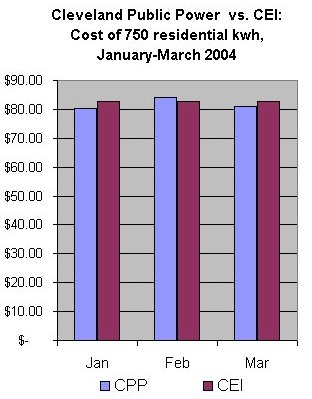
CLEVELAND PUBLIC POWER MAKES HISTORY... But no press release, please. In February, for the first time in living memory, electric bills for at least some residential Public Power customers were higher than bills for the same service from CEI/First Energy.


According to the PUCO's monthly Utility Rate Survey, CEI's monthly charge for 750 kwh in January, February and March was $82.64. CPP's bills for the same usage were $80.28 in January, $83.98 in February and $80.87 in March. The February CPP bill was 2% higher than CEI's.

The February spike in CPP's energy charge was a small anomaly -- the "typical" CPP customer still had a tiny savings over the "typical" CEI customer (about 1%) during the whole first quarter. And the gap during the five summer months may be greater (it was 5% to 9% in 2003). But February's mini-historical event illuminates the shameful fact that Cleveland Public Power -- which still likes to posture as the affordable, competitive alternative to high-cost CEI -- has stopped being part of the solution for city consumers, and is now part of the problem.

The meaningful point of comparison for both Cleveland utilities is the average 750-kwh bill paid by customers of Ohio's other major private electric companies. i.e. those not owned by First Energy. In March, that average was $62.60 -- 29% less than Cleveland Public Power.

4.19.2004

COMPUTER VOTING IN CLEVELAND? From the Greater Cleveland Voter Registration Coalition via What's Up:

Voter Verified Paper Trail for Electronic Voting -- Town Hall Meeting
Friday, April 23, 2004
Laborers Local 310 AFL-CIO Hall, 3250 Euclid Avenue, Cleveland

Demonstrations of machines with verified paper trail capability from 4-6 p.m.

Discussion from 6-8 p.m. with State Senator Teresa Fedor; State Reps. Peter Ujvagi, Mike Skindell, Claudette Woodard, Shirley Smith, Annie Keys; U.S. Congress Rep. Marcy Kaptur; Bev Harris, author of Black Box Voting

Make sure your vote counts. Don't let the computer eat your ballot. No matter what your political party, your vote must count.

Sponsored by the Greater Cleveland Voter Registration Coalition.


Bev Harris' website is Black Box Voting. It offers a free PDF download of her book of the same name.

4.17.2004

CUT BEACHWOOD CITY COUNCIL: The Free Times editorial called "Cut City Council" is unsigned, but it sure sounds like Editor-In-Chief David Eden, so at first I thought it was about Beachwood. After all, Beachwood Dave's hometown of 12,000 people has not only a full-time Mayor who makes more than $80,000 a year, but seven part-time Council members... not to mention its own Police Chief, Fire Chief, Building Commissioner, Finance Director, Law Director, Service Director, Community Services Director, etc., etc.. As the editorial says, this does seem a bit "top heavy" for a community with half as many residents as the average Cleveland ward. And I know Beachwood Dave is a hometown community activist, having run for that very remunerative mayor's job a few years ago. (I guess that's how he knows so much about mayor stuff, like he keeps reminding us.)

But then I realized that the editorial is talking about my home town, where the average ward's 23,000 people (who would be Cuyahoga County's 12th biggest city if they seceded) get exactly one elected person to represent them and deal with their daily mountain of neighborhood problems and complaints.

So, okay, Beachwood Dave or whoever wrote this nonsense, listen up: I've been active in neighborhood work in Cleveland for twenty-two years, through three mayors, four Council presidents and about a million downtown/suburban schemes du jour for "bringing back the city". The only real improvement in Cleveland's civic structure during that twenty-two years has been the strengthening of the local Council Members' role in day-to-day neighborhood governance -- the result of better staffing, reliable "ward allocations" of CDBG and other funds, working partnerships with community development groups and planning staffs, and (frankly) smarter Council Members.

Some Councilmen do it better than others, of course, which is why we have elections. But generally the system works far better at the neighborhood level than it did twenty years ago -- which makes it just about unique in modern Cleveland experience.

It works because the territories and populations of the wards -- like those of most suburban municipalities -- are human scale. Council Members who put in the normal fourteen-hour days can return their calls, get to community meetings, pay attention to local project and budget issues, communicate with the safety and service departments, and still show up to legislate. They have a fighting chance to know constituents personally. And when they come up for election, they -- and their opponents -- can still campaign effectively without huge campaign budgets.

Access for ordinary citizens. A capacity for local problem-solving. Face-to-face politics. Yes, it's all a terrible waste of money.

The citizens of Beachwood need to put a stop to it. And Dave Eden is just the Beachwood citizen to get the ball rolling.

Maybe that will keep him too busy to screw up my city.

4.16.2004

SCHOOL BUDGET, UP CLOSE AND PERSONAL: Max Hayes teacher MB Matthews makes it real.

4.15.2004

SHAMELESS PROMOTION DEPARTMENT: I work for Cleveland Digital Vision, a coalition of groups organized to strengthen community technology and tech literacy efforts in Cleveland neigborhoods. We often work with Computers Assisting People, which fixes up and donates hundreds of used computer systems to local nonprofits every year.

On May 12, our two organizations are holding Plug In Cleveland 1.0, a big party to raise money, honor some of the city's unsung Digital Divide heroes, and have a really good time. It's at the Midtown Innovation Center, home of Orbital Research, CleveMed, NeoBio and similar cutting-edge techies. We expect a great crowd, including George Nemeth, Craig and Sue James, Stan Miller of Neighborhood Centers, Chris Warren of Shorebank, Cindy Andrews of IBM, Tom Furnas of ideastream, Tony Houston of the Empowerment Zone, Jim Cookinham, Dan Hanson... well, you get the idea. Not to mention lots of the people who are out in the neighborhoods working for digital literacy and opportunity every day.

It costs $25. You should come. Learn more here. Get your ticket here.

4.14.2004

CLEVELAND SCHOOLS SHORTFALL IS $100 MILLION: Channel 5 had "exclusive tape" last night of Barbara Byrd-Bennett choking back tears as she told a School Board meeting about a letter from the Governor announcing more state funding cuts. The Plain Dealer has a less theatrical account of the situation this morning.

For actual information about the School District's finances, see this article in the January Catalyst for Cleveland Schools, which provided some line-by-line background to Byrd-Bennett's November "State of the Schools" speech. And while you're there, read Charlise Lyle's companion editorial, which began:

If the business and political leaders of Cleveland and Cuyahoga County had their priorities straight, Cleveland voters would soon be casting ballots on a much needed school operating levy. Instead, when they go to the polls March 2, they likely will vote only in the primary elections.

And Cleveland's school children likely will pay the price next school year through deep cuts in school staffs, textbooks and transportation.

Civic leaders have known for some time that Cleveland schools are due for an increase in the operating levy; it's been seven years since one appeared on the ballot. They also know that the schools desperately need the money.

This year, the district is operating on a no-growth budget even though costs have risen. And recently, schools chief Barbara Byrd-Bennett made clear that still more budget cuts are on the way. Yet our civic leaders have spent all their time trying to ramp up for ballot requests to finance other projects that, ultimately, failed to win the public's support.


Uh-huh.

The proposed cuts described in today's PD article are just the beginning. Reportedly the district, which must approve the 2004-2005 budget by June 15, will lay off up to 1,400 workers including hundreds of classroom teachers. Then we'll have a levy on the November ballot, which has been floated as 10 to 15 mills (but would have to be more to reverse all these layoffs and program cuts). 15 mills is close to $30 a month for the owner of a $75,000 home.

Who's in charge of this slow-motion train wreck? Byrd-Bennett is cast as the protagonist, but she's ultimately just a $300,000-a-year hired hand. The School Board has to pass the budget and authorize the levy, but they're an obscure, unelected sounding board for the CEO. The only elected official responsible to the voters for the affairs of the School District is... Mayor Jane Campbell, who appointed them all.

Yup... we're about to see how Mayoral Control works when the shit hits the fan. Would an independent, elected School Board have allowed the rest of our "civic leadership" to put off the levy this long? Will this unknown, unelected Board have any credibility with the public when it counts -- either in explaining major program cuts or asking for a big tax hike? Or will this all come down to the shredded coattails of the Mayor, whose career would be ended by a loss, but not necessarily ensured by a win?

All this and the Presidential election, too. It's gonna be quite a Summer.

AND SPEAKING OF THE CLEVELAND SCHOOLS... Here's a little peek at someone doing it right, from MB Matthews.

4.06.2004

ABOUT THOSE 308,000 JOBS: Don Iannone echoes the general elation about the national job growth figure for March.

Here's a less enthusiastic perspective from MaxSpeak:

If you like the payroll "establishment" survey, we have fewer jobs now than when the recession ended in 2001, an execrable record.

If you like the household survey, reputed to reflect the creative upsurge of self-employment and entrepreneurial initiative, job growth for the past two months is negative, and the employment level now is lower than in the fourth quarter of 2003.

So tell me again how the tax cuts have worked? What events would signal that they had not worked?


Some more detailed analysis along the same lines here.

The Bureau of Labor Statistics won't have state and metro-area breakdowns of these figures until mid-month. I'll be watching this site with great anticipation.

P.S. Just took a closer look here and realized that "mid-month" is off by a fair amount. The BLS release date for state-by-state job numbers is April 23; for metro-area numbers it's not till April 28.

4.02.2004

OUTSOURCING: One of my two favorite bloggers on national economic issues is Brad DeLong, former Assistant Treasury Secretary for Economic Policy in the Clinton Administration who's now teaching at Berkeley. (The other is Max Sawicky of the Economic Policy Institute, who argues with him on a regular basis.)

This morning DeLong put up two long posts about the "outsourcing issue". The first is a draft of an article he's writing with his Berkeley colleague Stephen S. Cohen. The second is a long quote from a piece in this morning's Wall Street Journal by David Wessel.

You should read them.

3.30.2004

WHY FIRST ENERGY FEARS REGIONALISM: From the Sunday PD, in a historical sidebar to the "Region Divided" article (page A13, not online):

1901: Tom L. Johnson is elected Cleveland mayor. In a city without suburbs, he pushes reforms that equate to early principles of regional government: home rule, public ownership of utilities, a professional approach to government and planning.

So this is all a plot to expand Cleveland Public Power to Bay Village and Solon. Now I understand...

3.29.2004

NANO, NANO: The speakers at NEOSA's "Futures Forum" last week were all pretty interesting, but the guy I wanted to corner after the show was Scott Rickert of Nanofilm, who asserts joyously that the Great Lakes Rustbelt is well on its way to becoming the NanoBelt. Nanotech, Rickert says, is all about a new generation of materials that are inevitably going to replace the metals, plastics, etc. that now surround us. The U.S. and the Great Lakes states in particular have a big lead in this technology -- says Rickert -- and there's no reason to think it can't become NE Ohio's big new manufacturing sector.

After the session Rickert elaborated: nano materials are so light that shipping from anywhere to anywhere is cheap; the only raw material needed in quantity is water; and labor is only 2-3% of production cost, so labor cost is immaterial. Hmmm, I asked, so is that because nanotech production needs very few workers? Yes, Rickert replied; very few and very well educated.

So there's a possibility to chew on -- a future NE Ohio with lots of high-tech manufacturing that pays high wages but employs almost nobody.

Chris Seper advises me not to take Rickert's image of jobless manufacturing too literally, pointing out that Nanofilm has a real workforce at its Valley View facility. So... who knows? A story worth following...

And speaking of Chris and nanotech, his blog today features this helpful Infograph on the subject from the Onion. Mmmmm, ice cream!

3.26.2004

INQUIRING MINDS NEED TO KNOW: I just ran into this terrific line attributed to William Gibson: "The future has arrived; it's just not evenly distributed." Can anybody tell me the source?
PRIORITIES: The PD editorializes somberly this morning about the Cleveland School District's announced budget cuts.

There is no arguing the district's desperate financial straits. The last several months have witnessed midstream cuts in state aid, dwindling property tax revenues and fast-climbing charter-school and health-insurance costs... The district plans to address one half of this equation by seeking new taxes in November. Residents last approved a city schools levy in 1996, but back then the economy hummed, and the city hadn't laid off more than 300 safety workers. Even if school officials secure a miracle win this year, the money won't arrive in time to avert the certain downward spiral forced by this spring's cuts.

The district escaped academic emergency status just last fall, a proud moment. But it will be desperate once again when classes open this August. The near future looks ugly, and the sooner citizens accept this reality, the better chance Cleveland has of launching speedy repairs.


But for some reason the editorial fails to mention why the school levy was put off until this November instead of going on last Fall's ballot, when the coming crisis was already evident to every public official, business leader and editorial writer in town.

Children, can you say "convention center"?

3.25.2004

FREE CULTURE FOR FREE: The entire text of Lawrence Lessig's new book, Free Culture, is available for free download here.

3.24.2004

WITH FRIENDS LIKE THESE... The Plain Dealer reports this morning that everything you suspected about your official "consumer advocate" in Columbus is true:

Former Ohio Consumers' Counsel Rob Tongren "deliberately concealed from the public" a consultant's findings that might have slashed electric bills in FirstEnergy territory, a state investigation has found.

Tongren's senior staff members, meanwhile, appeared to have urged the consultant - Boston-based LaCapra Associates - in a series of e-mails "to destroy their own records of the report and the underlying work product," says the report, which was released Tuesday.

It also says Tongren, who has since resigned from his job representing utility customers, accepted meals, refreshments and golf outings from utilities 71 times between 1999 and 2003. He failed to properly report more than $1,000 in gifts.

Tongren also was reported to have paid his own way, or gotten in free, to dozens of events at which utility executives and lobbyists were present, including an excursion to the Fiesta Bowl in 2003 on Columbia Gas' jet.


Tongren's replacement, Janine Migden, has taken some flak for her stint as an Enron lobbyist. But among the people who applied, she was probably a pretty good pick. She started her law career as a paralegal at the OCC back in the '80s, when Bill Spratley, the original Consumers' Counsel, was still making an effort to act like a genuine consumer advocate. And as lawyer for Hahn Loeser in recent years, she's been something of a green power activist, serving on the board of Green Energy Ohio among other things.

Frankly, anything's got to be better than Tongren. For a little update on what lies in store for Migden -- and northeast Ohio utility consumers -- see Ohio Citizen Action's clips today.

3.21.2004

CMSD GRADUATION RATE STILL UNDER 40%: BFD posts a quote from teacher Mary Beth Matthews:

We cannot attract businesses to the region without a trained workforce. The regions largest school district is hemorrhaging students. Cleveland's student population numbers over 70,000. The district's graduation rate is only 38%. Realize, that means 62% of those 70,000 will not receive a high school diploma. That is HUGE. The implications are staggering.

Those who discuss revitalizing the region, without considering Cleveland's education crisis are like physicians trying to treat the symptoms while ignoring the cause.


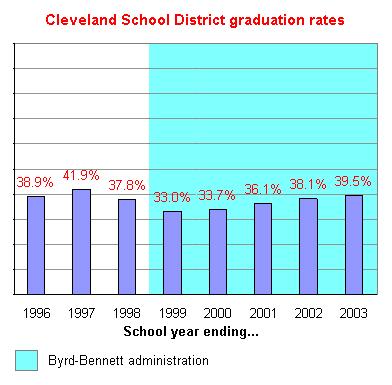
Amen. And to underline Matthews' point, the new "State report card" for the district is out with the 2002-2003 graduation rate -- 39.4%. That makes the sixth straight year Cleveland's grad rate has been under 40% of entering ninth graders. Here are the last eight years:


Barbara Byrd-Bennett is fond of saying, most recently in her November speech to the City Club, that the graduation rate is up ten percentage points since she arrived. As you can see, the "report card" numbers don't support this claim.

Neither ODOE nor CMSD makes the data underlying the "official" grad rates available, so we don't know what these percentages really mean -- and it may be true that the district's data problems help to make it look worse than other "urban districts" in Ohio. But that doesn't change the reality that thousands of Cleveland high school kids continue to leave without a diploma, and that the situation is just about as bad now as it was in the state takeover period, before Byrd-Bennett took the reins.

Every year this continues means at least a couple of thousand new entrants in the city's work force without diplomas. When the last census was taken in 1999, Cleveland's percentage of adults without diplomas (31%) was the sixth highest among the fifty largest U.S. cities. And ominously, the 1999 count found that a full 38% of Cleveland's youngest adults -- 18-to-24-year-olds -- had neither diplomas nor GED certificates.

3.19.2004

HEY, I'M AN URBLOG: I know about Otis White's Civic Strategies site mainly because BFD keeps bringing it up. This morning, however, having finally gotten my blogroll to function, I went googling for any links to Cleveland Diary that I should reciprocate. And up pops this on Mr. White's site...

Urban blogs are those that are focused on a metro area, provide interesting commentary about local politics, culture or urban life and aren't so ideological that they're painful to read. So how much ideology is too much? Hey, it's our list, so we get to decide...

Here's our list of urblogs worth spending time with:

Bill Callahan's blog is a jewel. He writes frequently and well, not only about Cleveland politics but economics. And he does so with an independent point of view. You can find Callahan's blog at...
[you're already here].

Well. I guess George is right -- Otis is the man. How often do you get not just a nice review, but number one billing in a whole new cultural category? (Okay, "urblog" is more of a sub-sub-sub-sub-category, but even so...)

Hey Mom, I'm an urblog!

The other links on the page, from various cities, are interesting and nice company to be seen in. And note that White's looking for nominations for more urblogs to list.

Go ahead, feel free, I don't mind. My place in urblog history is secure.

3.18.2004

WHERE WE WORK: This week's Crain's has a new list of the "Largest Cuyahoga County employers" (there's a link to it on the web site but it doesn't work). Here are the top twenty in order of workforce size:

1 Cleveland Clinic
2 University Hospitals (including their partnership with the Sisters of Charity)
3 Cleveland Municipal School District
4 U.S. Office of Personnel Management
5 Cuyahoga County
6 City of Cleveland
7 Progressive Corporation
8 KeyCorp
9 National City Corporation
10 U.S. Postal Service
11 MetroHealth
12 Ford
13 CWRU
14 Tops Markets
15 Giant Eagle
16 Continental Airlines
17 State of Ohio
18 General Motors
19 RTA
20 Sherwin-Williams

These twenty employers currently account for 152,000 employees, which is almost one-fourth of the county's total employment (613,000 in January according to OBES). They include all county payrolls with more than 2,500 workers.

Only three of the top ten, and nine of the top twenty, are private for-profit companies. Five of the top ten are government entities (counting the USPS). Numbers 1 and 2 are nonprofit health care systems.

Of the 152,000 people working for the county's twenty biggest employers, only 42,000 -- less than a third -- work in the "private sector".

3.16.2004

DO-IT-YOURSELF COMMUNITY ENERGY POLICY: Don Iannone's ED Futures today points us to the Rocky Mountain Institute's Community Energy Opportunity Finder. Don says:

The Community Energy Opportunity Finder is an interactive tool that will help you determine your community's best bets for energy solutions that benefit the local economy, the community, and the environment.

Developed by energy experts at Rocky Mountain Institute, the Community Energy Opportunity Finder mimics the preliminary analysis of an expert consultant in order to help your community realize the benefits of wise energy use. The Finder was released in February 2004.

The Finder helps you collect information on your community's energy use, and then demonstrates the potential energy savings; dollar savings; reductions in carbon dioxide, nitrogen oxides, and sulfur dioxide emissions; and job creation from energy efficiency programs. The Finder also gives you an overview of the kinds of renewable energy sources that could power your community.

GEEK VS. NERD -- ALL ABOUT THE BENJAMINS: Chris Seper blogged yesterday from a business journalism conference where he learned the distinction between "geeks" and "nerds", to wit:

Nerds use knowledge to make money.

Geeks revel in the knowledge without doing anything with it.


Quite a range of possibilities, isn't it? I wonder where Berners-Lee fits in that model.

3.15.2004

LAKE FERRY -- WHILE CLEVELAND STUDIES, ROCHESTER SAILS: Daily high-speed ferry service between Rochester and Toronto starts April 30.

From the operator's press release on Canada News Wire:

Canadian American Transportation Systems is establishing a Fast Ferry service between Rochester, NY and Toronto, Ontario. The service will be "high speed", operating at over 50+ MPH, accommodating approximately 750 walk-on passengers, up to 220 cars and up to 10 trucks and buses. More than just a method of transportation, the Fast Ferry is truly a unique travel experience, offering amenities and ambience worthy of a mini cruise ship. Importantly, the two and a quarter hour "port to port" trip will act as a "virtual" bridge, connecting the national highway systems of Canada and the United States, and acting as a catalyst for two regions coming together, economic development, tourism activity and job growth on both sides of the border.

The Port of Cleveland has been studying the possibility of a ferry to Port Stanley since 1999. A draft of the latest million-dollar study is expected in April.

2.08.2004

NO MORE BUSINESS CYCLE HERE? A strange new establishment slogan popped up in last weekend's Quiet Crisis panel in the PD: National business cycles aren't important in Cleveland any more.

David Abbott: "We still tend to focus too much on business cycles. Thinking about [the future] in terms of the recession and recovery from the recession is a dangerous thing for us to be doing, because I don't think that's really fundamentally what's going on. We're really talking about a fundamental transformation of the economy in this region. We are, in effect, sort of leading the nation in some ways in the transformation of the national economy, and we have to come to grips with that and . . .We can't be lulled by the fact that we might come back as the recession ends."

Joe Frolik's summary: "Clevelanders need to realize that the old business cycle of recession and recovery is dead; productivity and global competition mean that lots of jobs lost during this recession are never coming back."

Mark Rosentraub: "If we accomplish one thing, and this would be enormous if we accomplish it, it is that people begin to understand that it's not a business cycle. We're not in a down cycle. We're at the cusp of a change in the economy and in demography, and we need to understand that and respond to it."

WE'RE NOT IN A DOWN CYCLE? Is that what the Dean of Cleveland State's College of Urban Affairs said?

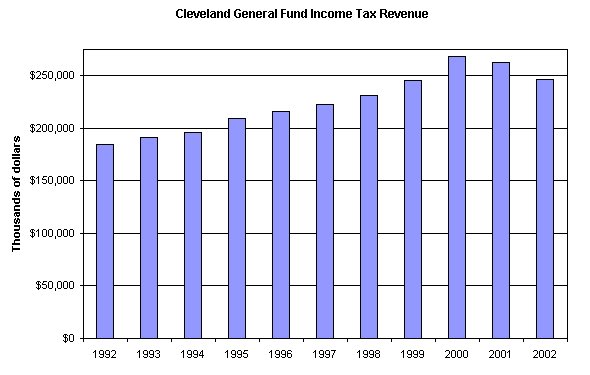
Click here for a chart of Cleveland city income tax receipts from 1993 to 2002.

Click here for a chart of quarterly job growth in the county from 1990 through 2003. And click here for a chart of Cuyahoga County sales tax revenue from 1990 through the present. (Last two links are from George Zeller's CEOGC research page.)

Looking at these charts, it's pretty obvious that something very bad started happening to the local economy in 2001, and it ain't over yet. What do you suppose that sudden event was? Did the "fundamental transformation of the economy in this region" just arrive that year? Did we trip over a cusp and fall down?

The answer, of course, is that a national recession started in March 2001, followed by the shock of 9/11 and a long "jobless recovery" that continues to this day. The U.S. economy is still more than two million jobs short of its employment level in March 2001. As with previous national downturns, Ohio and Cleveland started falling earlier, fell deeper and are taking longer to climb out. And since the whole economy still has a bad cold -- and quacks in charge of curing it -- Ohio and Cleveland are still bedridden.

(Incidentally, the same is true of Greater Seattle, which might be taken as evidence that a big tech sector, new wealth and a hot market for "creatives" don't make you cyclically immune -- if anyone was interested in evidence.)

Yes, the long decline of traditional U.S. manufacturing and the structural shift to service, financial and new-tech industries have clearly hurt greater Cleveland and made us more vulnerable to national downturns like this one. Yes, in the long run everyone in northeast Ohio has a stake in economic transformation. But Cleveland's immediate economic horrors -- our catatonic job market, our empty downtown, our record foreclosures and bankruptcies, and our disastrous local tax shortfalls -- are very directly tied to the national economy, and will improve significantly when and if the national economy starts adding jobs at a normal pace.

Abbott, Rosentraub, Nance, etc. know this perfectly well. So why claim otherwise in the newspaper? Why try to make The national business cycle doesn't matter any more the next thing that "everyone knows"?

Bad assumptions lead to bad policy. Cleveland already has too many half-truths (and a few outright falsehoods) being mouthed thoughtlessly by "informed" people. This one needs to go away, right now.

1.30.2004

COMPUTER TRAINING = JOBS? A PD op-ed (online not there but at the Washington Post) says George Bush's enthusiasm for computer training is somewhat beside the point in an economy that isn't creating jobs that use the trainees' new skills. Chris Seper comments. I respond at Cleveland Digital Vision.

1.22.2004

BLOGGING OF THE PRESIDENT NOT ON WCPN THIS SUNDAY: From Chris Lydon's blog via Atrios:

Sunday January 25 from 9-11 pm EST, from Minnesota Public Radio and airing on public radio stations nationwide (here's a list of stations playing the program). Christopher Lydon will be hosting the first sustained blog conversation on network radio and you’re all invited to join in. The purpose is to air out the internet effects that the political campaign has suddenly made obvious. We want to encompass the new voices and communities, the critique of institutional journalism, the expressive possibilities beyond politics, the doubts, the hype, and the truth. Among the guests will be Atrios, Andrew Sullivan, and many more (a lot of biggies, we'll be updating the site daily) including you, if you’ll tune in, phone in, or just blog it as we speak.

Neither WCPN nor WKSU is on the list of stations, and it ain't on WCPN's schedule.

WCPN's phone: 216-432-3700. Fax: 216-432-3681. Dave Kanzeg is director of programming. I don't have his email but you can write to comments@wcpn.org.

1.10.2004

MY BIG FOUR FOR '04: Here I thought I'd get all clever and kick off a new blogging year with a list of four big, big ideas that should move to the city's front burner this year. Good idea, yes? So good that David Eden beat me to it.

At first I was kind of deflated. Then I read Dave's list and cheered up. "Big ideas for the next hundred years?" Two more downtown real estate parlays (one with a sports gimmick attached), plus a bureaucratic reorganization, plus a bigger airport? (Gosh, you think they'll still be using runways in 2104? Or are we hoping for direct service from Medina County to Mars?) This does not exactly rise to the level of Alfred Kelly's canal move.

Okay, so if I'm so smart, what are my Big Four? Here we go:

1) Send Cleveland to college. Eden is right to put the expansion of CSU on his list, but "University Village" and Division I football miss the point totally. Cleveland now has the lowest proportion of adults with college degrees among the country's fifty biggest cities. Our best prospects for population growth come from the relative stability of poorer young people, plus immigration from Puerto Rico, Latin America and elsewhere. We need a university that's the absolute best at educating working-class students for scientific and professional careers and high-skill technical work. (Think City College of New York in the '30, '40 and '50s.) The community can help start CSU on this road by committing serious resources to send tens of thousands of our undereducated, underemployed adults and kids to CSU, and to help CSU develop world-class teaching and support systems for them. Let's change our city from the worst educated to one of the best educated in its class!

2) Play the Canada card. Let's stop beating around the Great Lakes Regional bush and get to the point: we're closer to London than to Columbus, closer to Toronto than to Cincinnati, and there's no reason why a few miles of water should stop us from linking up. Look at a map without the national borders: what great metropolis should be our natural center of gravity? Where would I-77 and I-71 go if they could? Maybe Jim Rhodes was right about a bridge, maybe not; but it's not necessary to argue about it because we can put a ferry in service for much less than the Port spent on the Rock Hall, and open up a whole new northern neighborhood. This is a total no-brainer. Let's stop studying the possibility and get on with it!

3) Home grown affordable energy. Northeast Ohio is a huge importer of natural gas, and we pay some of the highest electric bills in the U.S. In the city, many of those bills come from Public Power, which charges almost as much as First Energy and sends a lot of the money elsewhere for purchased power. This all impinges directly on household and business budgets, drains dollars out of local circulation, and represents missed opportunities for local enterprise. Plenty of people are on top of this -- Entrepreneurs for Sustainability, Green Energy Ohio, H2O, EcoCity, etc., etc. -- but energy tech is a big long-term local market with a lot of entry points that deserves more public focus than it's getting. (And here's a really fascinating "big idea" that somebody in Cleveland should be checking out.)

4) Neighborhood government. It's arguable that some public functions in greater Cleveland would be strengthened by more "regional" public authority -- economic development investment, transportation, broad environmental and land use oversight, etc. It's equally arguable that Cleveland neighborhoods suffer from too much centralized control of things that small suburbs are very happy to run for themselves -- playgrounds, street repair, local planning and zoning policies, not to mention the process of democracy itself. Each of Cleveland's 21 wards has as many people as the average Cuyahoga County city -- cities that have their own governments, taxing and bonding authority, and civic institutions. It's hard not to notice that most people, given a choice, choose to live in the smaller places with human-scale governments. Meanwhile, in Cleveland, virtually all our vaunted neighborhood revitalization of the last twenty years has been driven by neighborhood development agencies (the CDCs) in alliance with ward Councilmen empowered by growing "ward allocations" of funds under their control. Left to centralized City Hall departments, none of it would have taken place -- no matter what past and present Mayors would like you to believe. If 2004 is going to see a real debate about government reorganization, that debate must help to sort out where power and policy initiative should be scaled down to the neighborhoods, not just up to the county or region.

So that's my Big Four for '04. I think I'll try to make them the biggest part of Cleveland Diary's agenda for the coming year. Better than just bitching and moaning about politicians, right? Of course I also put a big priority on computerizing and networking everybody in the city, but you can read about that at www.digitalvision.blogspot.com. And somewhere along the line I have to explain why I think more unions and collective bargaining are vital for the whole northeast Ohio economy. And I'm sure there will be other things I just gotta yap about.

But these should keep me busy for a while.

1.05.2004

PUTTING CHILDREN FIRST... OUT ON THE STREET: I ran into Tim Wells in the soft drink aisle at the Clark Ave. Topps on Saturday. Tim ran Clark Recreation Center in the Stockyards neighborhood, back when I worked for the local CDC. Now he's in charge of the Recreation Division's citywide "organized sports" programs -- what's left of them after the budget cuts.

Tim told me that the 16% cut in the Parks and Recreation budget means that about 300 Summer rec workers won't be hired this year, which means very short staff for programs at the City's 20 recreation centers and 19 neighborhood pools -- and no staffed programs at 30 neighborhood playgrounds that had them last year. The 19 pools will only be open for six weeks, from Tuesday through Sunday.

Think about this for a minute. The City of Cleveland has about 470,000 residents, of whom something like 100,000 are school-age kids. Last Summer, the City had over sixty places where those kids could go for some kind of organized, supervised recreation -- one place for every 1,500 kids, more or less. This Summer, thirty of those places will be gone, and another nineteen (the pools) will be closed for half the season. The ratio of staffed recreation sites to kids will fall as low as 1 to 5,000.

So if you want your child to play safely in a Cleveland neighborhood playground this Summer, and you don't happen to live near a rec center, get ready to go down there and stand guard for a few hours. Be sure to bring a broom and some trash bags along for last night's crop of broken glass... the City will only be cleaning once a month. And try not to do anything that could get you sued, since the City offers no liability coverage for parental volunteers.

Oh, you're working days? Too bad... guess you'll just have to lock the kids in the house with the X-Box for company.

Boy, this is gonna be an awful year.

11.26.2003

LET ME REPEAT MYSELF: From October 10...

No potential candidate for Mayor should get a free ride on this. Reporters and citizens need to make all the players come clean on their budget positions, long before this turns into a posture-fest at the Council committee table. If you think people need to be laid off, who goes first? If there's "fat" to be cut, where is it specifically? If you don't have some useful leadership to offer now, don't come to us talking about leadership in 2005. No Schwartzeneggers need apply.

Of course, this can't happen if all the numbers aren't public.

... The 2004 General Fund projections (and the 2003 numbers to date) -- all the projections -- should be posted prominently on the City's website right now, and updated as the Administration's information changes. This issue, far more than lakefront design or even the Convention Center, cries out for an open transparent public process: "We will have a lot less money than we need next year. What should we do about it?"
MAYOR'S FULL BUDGET STATEMENT ON LINE: I'm happy to report that Mayor Campbell's full statement on budget cuts Monday, and the accompanying press release (with a significant amount of additional detail), are now both available at the City website.

This is a very good first step toward a full, public, transparent debate on the City's financial choices. A good next step would be posting Finance Director Baker's latest revenue results and projections, and the details of proposed cuts, department by department.

If you agree, here's the Mayor's e-mail form.
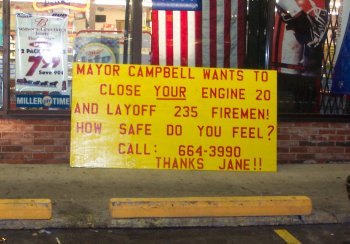
THE FIRST CASUALTY: The sign is still out there at my neighborhood Convenient store, two days after everyone in the city -- including the guys next door at Fire Station 20 -- learned that Mayor Campbell plans to lay off 150 firefighters, not 235, and is proposing to close no stations.

The sign is a lie now, of course. But since nobody signed it, I guess nobody's responsible for correcting it or removing it. It can just sit out there, telling the neighbors something that isn't true but still serves the purpose of the folks who put it up... much like the "2,000 new city workers added in the 1990s" myth that the Mayor's Office apparently promoted to the Plain Dealer, which put it in an editorial and still hasn't corrected it.

Like the Mayor's chief of staff supposedly said to the Firefighters president, "This is war". And in war the first casualty is the truth.

11.24.2003

Campbell plans to cut 700 jobs

Cleveland Mayor Jane Campbell plans to cut more than 700 city jobs, delay the opening of outdoor swimming pools and scrap eight fire companies to help eliminate next year's $61 million budget deficit.... The Parks and Recreation Department and the Service Department, which handles road repair and trash pickup, will each lose 60 jobs... The city will eliminate 60 part-time jobs and not hire 310 seasonal employees for such tasks as snowplowing and trash pickup.

So tell me again, after all the agonizing and hand-wringing, why is a temporary income tax increase not on the table? A quarter-percent surcharge for the last three quarters of 2004 would raise nearly half of the shortfall -- if it was on the ballot March 4 instead of a Convention Center tax. I believe it could pass, given the alternatives.

The safety forces may be grandstanding and exaggerating the dangers, but I can tell you from bitter experience that closing eight fire stations will slow response times and risk lives. And if you think that safety, recreation, and street repair failures aren't serious "quality of life" issues that will drive middle class families out -- along with the laid off workers themselves -- you just haven't been paying attention.

Correction... The Mayor's proposal calls for eliminating eight fire companies, not stations. Apparently a company is the crew of a truck, more or less. There is no proposal on the table to close any stations. This is a obviously a big difference. The Mayor says trucks and response times can be protected through changes in work rules, i.e. one fewer firefighter per truck.

11.23.2003

MY REGIONAL GOVERNMENT PLAN (A THOUGHT EXERCISE): In this media market if not elsewhere, "regionalism" has become one of those words that obscures more than it communicates. Everyone from Thomas to Sam Fulwood, from Peter Lawson Jones (speaking at the last Connections Series event) to the fourteen biggest Cleveland law firms wants to talk "regional government". Elsewhere we're asked to think in terms of the bioregion, the northeast Ohio economic region (nineteen counties, according to REI's Ed Morrison), the "Great Lakes region" (Detroit to Buffalo with part of Ontario thrown in), etc., etc..

So what do they all mean by "region"? Certainly not the same thing. I'm pretty sure that Thomas and Lawson-Jones aren't proposing to create a municipal government that covers Lorain and Akron, while David Beach certainly doesn't think that the bioregion follows county lines. But by sharing the magic word "regional", all these disparate undertakings somehow hum at the same frequency in the public dialogue -- one big "progressive, visionary, 21st century" political harmonic. Sounds real pretty, doesn't it?

Now as my three regular readers know, I think there really is a distinct economic and political entity in Northeast Ohio -- more or less the same territory as REI's nineteen counties -- and I think we should have our own state, or something close to it. But there's a big difference between wanting to devolve centralized political authority to smaller, more locally-empowered entities (a value which is usually called subsidiarity), and wanting to merge smaller political authorities into a bigger one. You can call them both "regionalization", but they're two entirely different things.

"Centralization" is what we're discussing in Cleveland today... the merger of some or all municipal powers from a number of long-existing cities and villages into a single, bigger new municipality of some kind. What, why, who and how are still very vague. So to help clarify things, I want to offer -- purely as a thought exercise -- my very own municipal regionalization plan.

I call it the "BIGGER CLEVELAND PLAN" (and hereby claim copyright on the name, just in case some consultant tries to make a buck off it later).

Here's the way it would work: All of the cities currently sharing a border with the City of Cleveland would simultaneously offer to annex themselves to the City of Cleveland, along with their school districts. The City of Cleveland would accept their offer. Period. Full stop.

Of course nothing is that simple. The City of Cleveland's Home Rule Charter would have to be amended to redraw ward lines to include all those new citizens. And the process of incorporating the assets and employees of the various disappearing suburbs into Cleveland's would be complicated and stressful (no doubt providing all the legal work that those fourteen law firms are hoping for). But with strong, self-effacing leadership from all sides -- the kind of leadership everyone is demanding now from Jane Campbell and Frank Jackson -- I'm sure we could get through it.

In order of population, the annexed cities and villages would include Parma, Lakewood, Euclid, Cleveland Heights, Garfield Heights, Shaker Heights, East Cleveland, Maple Heights, South Euclid, Brook Park, Fairview Park, Warrensville Heights, Brooklyn, Newburgh Heights, Brooklyn Heights, Bratenahl, Cuyahoga Heights, and Linndale.

These eighteen municipalities -- the actual "first ring suburbs" -- have a total of about 450,000 residents, so their annexation would almost double Cleveland's population to over 925,000... back to Number 1 in Ohio and Number 11 in the U.S.

The combined Bigger Cleveland would have:
-- a poverty rate of 17%, compared to Smaller Cleveland's 26%
-- 19% of its adult residents with college degrees, compared to Smaller Cleveland's 11%
-- a public school system with a significant number of middle-income children and parents (at least at first) and a significant number of its teachers and administrators actually living in the district
-- lots of nice neighborhoods for its city employees to live in, even with the residency rule
-- some really nice new city parks and recreation centers open to all Cleveland residents (ever been to Brooklyn's Natatorium?)
-- a stronger property and income tax base, including some still-growing commercial centers and industrial parks
-- lots more political clout.

Of course, Smaller Cleveland residents would lose some political ground, too, since the former suburban voters would outnumber us in Bigger Cleveland (and they turn out better, too). African Americans in Smaller Cleveland would find themselves back in the minority, after decades of edging toward real political dominance in the city... a serious sacrifice for a community whose voting strength is currently its only way to get to the jobs-and-power table.

Nonetheless, I believe that, on balance, the Bigger Cleveland Plan as I have proposed it would be seen by most Smaller Cleveland residents as too good an offer to pass up, if only for the potential value to our schoolkids. And it has the advantage of being very straightforward: All we need is for those eighteen inner ring suburbs to get together and decide to be annexed to Cleveland, as provided under current state law.

Of course it would have to start with the eighteen suburbs themselves. I would think a good start would be for well-known regionalization fans Peter Lawson Jones and Jimmy Dimora to go around to all the city councils, school boards, and ward clubs in those municipalities to get the ball rolling. They could undoubtedly count on getting help from lots of local residents -- for example, attorneys from the fourteen biggest law firms -- who share the regional vision and are tired of being held back by the old-fashioned, parochial, inefficient communities where they live.

I would personally pay good money to hear those conversations -- especially Lawson-Jones making a pitch to the Shaker Heights school board.

Well, that's my Bigger Cleveland Plan. I wonder how long it will take for the petitions to start circulating in Shaker Heights, Cleveland Heights, Euclid, Parma and Lakewood? Or to put it another way... when does ice skating season start in Hell?
11.17.2003

WHY A CONVENTION CENTER TAX ISN"T GOING TO PASS IN CLEVELAND:


At my neighborhood Convenient store this evening
(West 25th and Archwood)

11.08.2003

ISSUE 1: TECHS AND THE CITY

How State Issue 1 did in the City of Cleveland:


(Ward map here.)

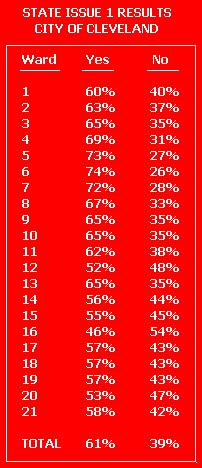
Issue 1 got majority support in twenty out of 21 Cleveland wards (the exception was Ward 16, Old Brooklyn). It broke 60% in all eleven East Side wards as well as Ward 13 (Tremont-Downtown-Goodrich Park).

The overall City result of 61-39% was basically identical to the rest of Cuyahoga County at 63-37%. But Cleveland's voter turnout of about 38,000 -- 11% of eligible adults -- was far lower than the rest of the county, where almost a third of all adults voted. This is not surprising -- Cleveland had only three judgeships and Issue 1 on its ballot, whereas many suburbs were electing mayors and city councils and voting on high-profile issues -- but it was unfortunate for Issue 1 backers, who might well have netted 15,000 to 20,000 votes from a higher city turnout. (The issue failed by only 45,000 votes statewide.)

On its face, there was nothing exceptional about the city's support for the issue. It was strong in this county, in NEO generally, and in Democratic-voting areas; it was weakest downstate and in Republican-dominated areas. While Issue 1 was sponsored by a GOP governor with the support of a GOP legislature, its basic pitch -- big new government investment to create new high-paying tech jobs -- seemed far more resonant for labor and city Democrats than for most white-collar Republicans, let alone farmers. And that's pretty much how the votes fell.

But I think Cleveland's vote is worth some attention nonetheless. Remember, these are the same voters who, according to polls, would have buried a Convention Center tax if it had been on this ballot. These are the people who are dismissed by some as too short-sighted, parochial and manufacturing-obsessed to embrace a new golden age of entrepreneurial wealth creation and creative-class high life. Thus this is the city whose very political existence is seen in some quarters as an obstacle to regional progress and prosperity.

And now it turns out we liked the Third Frontier better than they did in the Columbus and Cincinnati suburbs. Why, Frank Jackson's Ward 5 went for it by more than 70%!

Maybe the champions of NEO's new economic paradigm(s) have been looking for love in the wrong places.

More on this next time.

11.06.2003

FOR ALL YOU WIFI FREAKS: Via the Community Technology Centers Network mailing list, a new website on "muni wireless".
MORE WAL-MART: Yesterday's New York Times has a long article on the Wal-Mart cleaning contractor case, which led to recent arrests at the chain's North Olmsted store along with sixty others.

Various sources in the story say store managers must have known illegal workers were cleaning their stores. The workers interviewed came in on tourist visas, worked long hours for months at a time without days off, and earned less an $7 an hour with no overtime pay. But there's a heartwarming high-tech edge to the story: They were recruited on the Web!

Robert, a Czech who runs a Web site to attract Eastern Europeans to janitorial work, said using foreign cleaners was good for Wal-Mart and for American consumers.

"No American wants to do this job," he said. "If they hired Americans, it would take 10 of them to do the work done by five Czechs. This helps Wal-Mart keep its prices low."


Ah, good old forthright ethnic pride. I'm amazed he's not featured in a Wal-Mart TV ad.

11.04.2003

ROLDO: George Nemeth reveals that Roldo Bartimole's next column on Cool Cleveland responds to some earlier entries here and here. (You have to scroll down Roldo's column to get to this... it's the last section headlined "Consequences". )

The first thing I want to say is that I'm so happy that Roldo has a home on line with Cool Cleveland. Can you imagine any other well-known writer in this town being as scrupulous and diligent as this? Thank you, Mr. Mulready and Co.!

Roldo's column speaks for itself (including taking exception to my lumping him in with Crain's as a layoff enthusiast). But what's really interesting is Finance Director Baker's acknowledgment that the last ten years' job growth in City departments was closer to 600 than it was to 2,000 -- the number cited by editorials in both Crain's and the Plain Dealer, as well as Roldo's original City News column.

Why is it so interesting? Because when I contacted Joe Frolik at the PD, who wrote the editorial in question, he told me his source for the bigger number was the Mayor's office. (Joe says he was cautioned that it referred to overall employment growth, not just General Fund departments -- but it turns out that the real numbers in both cases are almost identical.) So it seems that someone at City Hall -- someone who talks to PD reporters -- was eiher badly misinformed or fibbing.

Does it matter? Joe made the same point to me that Roldo makes in his column, i.e. whether it's 2,000 added workers or only 600, the bottom line is still a $50 million deficit that won't go away without some serious payroll cuts somewhere. I've pretty much said what I have to say about this already.

Whatever the City does about all this, however, it's guaranteed to create extreme civic nastiness if the debate is less than honest, factual and transparent. The Case of the Two Thousand New Employees is not a promising start.

10.29.2003

DOWNTOWN POVERTY DEVELOPMENT: I'm going to propose a new term now. The term is poverty development. I define "poverty development" as the deliberate application of public resources and policies to create jobs at poverty wages.

Please note that poverty development is not what happens when people are thrown out of work, or out of their homes, as the result of public policy. These activities may create poverty -- lots of it -- but that's not usually their goal, it's a side effect of some other goal. In poverty development, on the other hand, the poverty-wage jobs are a stated goal, the poverty-level wages are built into participants' long-range business plans, and ensuring a labor supply at those wage levels is part of the public development activity.

An example of poverty development would be the investment of hundreds of millions of dollars in public funds into a public convention center, in order to create business for hotels and restaurants that pay most of their employees less than living wages.

In this connection, I've posted a page of excerpts from CSU Urban Studies Dean Mark Rosentraub's pro-convention center "study" on my Cleveland Wages Pages website. The most relevant passages are highlighted in red, but the rest of the excerpt is there for context. What it says, in short, is:

A big part of Cleveland's workforce is uneducated and therefore unemployable in the better jobs we hope to create in the technology and financial sectors, so we need to keep growing the "hospitality sector" to provide jobs for them.

I had a long talk a couple of years ago with a young woman who worked as a housekeeper at the Ritz-Carlton, cleaning up after guests who paid up to $300 a night. She described a very demanding job where pay started at about $7 an hour and rose to $9 only at the top of a competitive "incentive" scale. The workers were virtually all Black, Hispanic or recent immigrants; many did not speak English. She had family members and friends at the Marriott who were working in the same circumstances.

These two hotels were flagship projects of the '80s, built with heavy tax abatements to "revitalize the hospitality industry" and "create good jobs for residents". What they created was dead-end jobs at $14-15,000 a year -- less than the City's definition of a Living Wage that's acceptable for subsidized projects --with no prospect of improvement. (Of the 2,500 hotel rooms built downtown since 1980, a grand total of 140 are cleaned by workers with union representation.)

When we talk about preserving and creating "hospitality sector" jobs for uneducated Cleveland residents, these hotels -- and the restaurants around them -- are what we're talking about. That's downtown poverty development. We've had lots of it in the past twenty years, during which the City has become -- predictably -- poorer.

If we're going to spend a lot of public money to benefit uneducated Cleveland workers, as Dean Rosentraub argues, there is another possible strategy: We could spend it to help them get educated and qualified for all those better jobs in technology, finance and health care.

But for some reason, nobody is calling for "leadership" in that direction.

10.28.2003

WEIRD SCIENCE (ECONOMICS DIVISION): As I read yesterday's PD article about organized labor pushing a new convention center initiative, the following sentence caught my eye:

In the 1990s, employment gains in Northeast Ohio's hospitality sector - which includes, retail, museums and hotels - almost equaled lost manufacturing jobs, according to CSU analysis.

Read that sentence again. See anything strange? Here's a hint: Do you think of shopping malls as part of the "hospitality sector"? Probably not... but it seems that's the way CSU's study was counting in order to make its highly political point.

The study, by Levin College of Urban Affairs Dean Mark Rosentraub, is available here in PDF format. Published last May, it was waved around a lot during the Summer by Convention Center Tax advocates, but I never looked at it until this morning. The sentence from the PD quoted above is based on a passage that starts on page 14 and continues on page 15, referring to "changes in job levels throughout Northeast Ohio during the 1990s":

There was a loss of more than 22,000 manufacturing jobs... The number of new jobs in the retail, amusement services, museum, and lodging sectors -- which when grouped constitute the hospitality sector -- was almost equal to the loss of manufacturing jobs.

A chart follows which shows the following sectoral job gains (among others) for 1989-2000: 17,314 jobs in retail trade, 191 jobs in hotels and lodging, 4,115 jobs in amusement and recreation, and 478 jobs in museums. The total of these lines -- 22,098 jobs -- is apparently the "hospitality sector" gain that is supposed to almost offset the manufacturing loss. "Retail trade" is three-quarters of that total.

Now I don't know how these things work in the economics biz. Maybe there's some good reason for Dean Rosentraub and his colleagues to have a construct called "the hospitality sector" that includes Wal-Mart, K-Mart, Topps, Builders Square, the corner gas station, the video store, the Dollar Store and some apple stand in Hinckley. But it's hard to see how the performance of such a "sector" tells us anything useful about the economic impact of Cleveland's downtown convention and tourist business.

But who cares?. It's a statistic. It comes from the Dean of a college at CSU. And it appears to document the vital economic potential of conventions and hotels for a desperate Cleveland economy... at least until you give it a second glance. So put it in the paper and let the yokels try to figure out if it actually means anything.

Well, fellow yokels, it doesn't. It's junk science... a pre-judged conclusion in search of some data to support it.

Of course there's always a lot of this stuff floating around Cleveland -- remember the 25,000 good jobs Gateway was going to produce? But it sure would be nice if PD reporters had better smell detectors... or if CSU, which reportedly wants to be regarded as a real research institution, would start asking its faculty (and even its Deans) to act more like scientists and less like shills.

10.27.2003

PLAIN DEALER REPEATS BOGUS CITY JOBS CLAIM: In an editorial today, the PD joins Crain's and Roldo in calling for layoffs of City workers -- as early as January -- to head off a projected $52 million deficit in 2004. And like Crain's and Roldo, the PD undergirds its hasty attack on City workers' livelihoods with a claim that thousands of jobs were added to City payrolls in the 1990s:

No one should be cheered by the prospect of public employees losing their jobs, and the administration must be careful to preserve essential services. But since the city added nearly 2,000 employees during the 1990s, careful reductions need not prove crippling.

As I pointed out here on October 7, this claim is wildly wrong. Here, again, are the facts:

I went to the library and got the actual employment figures for General Fund departments (not just General fund employees) for the last ten years, and here's what I found:
... The City added a total of about 600 full-time-equivalent positions from 1992 to 2002.
... About 150 of these FTE positions were in Muny Court.
... About 600 FTE positions were added in the Public Safety Department... including 200 police patrol officers, 60 firefighters, and 95 "institutional guards".
... All the other General Fund departments combined lost about 170 FTE positions from 1992 to 2002.


I'll be sending the full spreadsheet with these numbers to the PD tomorrow... after which I'll confidently await their correction. Anybody else want to see it?

10.26.2003

CLEVELAND CONNECTION: Since I sort of gave Wal-Mart a free plug the other day, and since we all like "Cleveland connections" so much, I want to take note of the fact that North Olmsted was one of the 61 Wal-Marts where Federal authorities arrested contract cleaning workers as illegal immigrants on Thursday.

The PD had a good front-page article Friday, which unfortunately doesn't seem to be on line. (If you missed it, here's USA Today for the overall story.) It seems the feds believe that the workers were being paid as little as $2 a day, and that top Wal-Mart execs were well aware of the situation.

Naturally, it's the victimized workers who are in custody. At least so far.

10.21.2003

MAYBE YOU ALL ALREADY KNEW THIS... but I just discovered that Walmart.com is selling new PCs for $200. Two new PCs, actually: the Microtel SYSMAR417 with a Lycoris (Linux) OS on it, and the Microtel SYSMAR550 with no OS loaded. They're both Duron 1.2s with modest hard drives (20 gig), no modem and no floppy... but shit, it's $200!

(Don't go to your WalMart store looking for these systems -- they're available on-line only.)

Microtel is a California company and seems to do actual assembly there, though I'm sure they buy their boards from Asia. Lycoris is a Linux distribution from a fairly new company in Redmond, WA of all places (maybe that's why its front page looks so much like Windows XP.) Both companies seem to be looking for other resellers.

Now I'm sure that there's a market to be made in NE Ohio -- heck, in my neighborhood! -- for a sub-$250 new PC with a user-friendly Linux system. Is some Cleveland entrepreneur already checking this out? Is anyone out there trying to figure out how Microtel does it? How about the guys from the Open Source Society?

Or is this one more piece of northeast Ohio's consumer market that WalMart wll get to keep all to itself?
WIRELESS WAFFLES: Belgian waffles and wi-fi... all for $5 !

This Sunday from 9 to 2 at Tremont Scoops -- it's a benefit pancake breakfast for Tremont Wi-Fi. Your money will help buy access points and wireless cards for more community hotspots like the one at at Scoops.

See you there.

10.13.2003

THIRD FRONTIER... NEW STATE ROLE IN BUSINESS? I know there was a PD article about this, but if it didn't lead you to take a look at the new Policy Matters analysis of State Issue 1 and what it means, go do so now. Don't just look at the Executive Summary, download the whole thing -- it's worth the effort.

The press spokesman for the report (thus, I assume, a major contributor) is Zach Schiller, the former PD and Business Week reporter, now Policy Matters Research Director. (If I recall correctly, Zach's byline was on the PD's very first "Quiet Crisis" article).

The report is neutral on passing Issue 1 this November, but points out that this constitutional amendment involves a lot more than some bond money for high-tech research and development -- for example, it would allow the state (and maybe local governments as well) to own shares in private corporations for the first time in a century and a half.

10.10.2003

EMERGENT BUDGET DEMOCRACY? BFD has a recent post on "emergent democracy" that might be worth considering in connection with the Cleveland Budget Perplex. The author BFD links to is talking about a new variety of self-organizing Web participation in the civic process, exemplified by the Howard Dean campaign. Since the majority of Cleveland residents are probably still without home computers, let alone good Internet skills, the relevance here may seem farfetched. But the fact is that an awful lot of Cleveland voters have crossed that divide in the past couple of years. Suppose the Campbell Administration actually put the numbers on the Net, where everyone can see them, and urged its constituents to start a serious conversation about them. Where might that lead?

Emergent democracy is about leadership through giving up control, activating the people to engage through deliberation and action, and allowing emergent order to grow from the grass roots.

Maybe we could use a helping of that in Cleveland.
CLEVELAND BUDGET PERPLEX 2: More thoughts:

1) There's a big hand-lettered sign on a fence on Scranton Road that says "Cut the fat, not the firefighters. Call Jane Campbell." One more sign of a long, hard budget season, that will only get longer and harder if the Mayor tries to finesse her problems with quiet deals and last-minute rabbits pulled out of Finance Director Baker's hat.

The Mayor says she has told all the department directors to show her how their budgets can be cut by 10%. Just remember -- this is a General Fund shortfall we're discussing. Three-fifths of the General Fund is spent by the Department of Public Safety. Therefore, three-fifths of a 10% across-the-board budget cut will be borne by that department. More than 90% of General Fund dollars in the Public Safety budget go directly to the Police and Fire divisions. So if there's going to be "fat" to cut, that's where the Mayor has to look.

Cut $20 to $25 million from Police and Fire, without cutting patrol officers and firefighters? Lotsa luck. But without some way to get revenue up, that's the quandary the City faces... which is why friends of the firefighters' union are already putting up signs.

2) My rumor mill tells me that at least two Members of Council are already raising money for mayoral runs. Whether this is true or not, it reflects the certainty that political and journalistic behavior on the 2004 budget issue will assume it's all about November 2005.

No potential candidate for Mayor should get a free ride on this. Reporters and citizens need to make all the players come clean on their budget positions, long before this turns into a posture-fest at the Council committee table. If you think people need to be laid off, who goes first? If there's "fat" to be cut, where is it specifically? If you don't have some useful leadership to offer now, don't come to us talking about leadership in 2005. No Schwartzeneggers need apply.

Of course, this can't happen if all the numbers aren't public.

3) I said this in passing a couple of posts back but I want to repeat it emphatically: The 2004 General Fund projections (and the 2003 numbers to date) -- all the projections -- should be posted prominently on the City's website right now, and updated as the Administration's information changes. This issue, far more than lakefront design or even the Convention Center, cries out for an open transparent public process: "We will have a lot less money than we need next year. What should we do about it?"

10.07.2003

CLEVELAND BUDGET PERPLEX: In response to my last entry, Mark Schumann comments:

But then you've got the old raising-taxes-in-a-recession problem. That's not good either. You can't push the payroll tax any higher, can you?

I think the answer is "Maybe yes, a little bit, temporarily, as an absolute last resort, if the alternative is laying off cops and firefighters". Which, Mark will note, is a highly political frame for the issue... but one which I think reflects reality.

Let me try walking through this step by step:

1) The huge increases in City workforce cited by Crain's and Roldo are mostly fictitious. I went to the library and got the actual employment figures for General Fund departments (not just General fund employees) for the last ten years, and here's what I found:
... The City added a total of about 600 full-time-equivalent positions from 1992 to 2002.
... About 150 of these FTE positions were in Muny Court.
... About 600 FTE positions were added in the Public Safety Department... including 200 police patrol officers, 60 firefighters, and 95 "institutional guards".
... All the other General Fund departments combined lost about 170 FTE positions from 1992 to 2002.

I don't have a clue what the extra Muny Court workers are doing or for how much, but for the sake of argument let's just say they're expendable. At $50,000 per slot, firing them all would save the City $7.5 million. That still leaves more than $42 million in projected deficit to be dealt with (and 150 newly unemployed people on the street).

Now what?

2) The Mayor and her staffers all just took voluntary pay cuts. Let's assume they can get all the non-civil service managers to do this. And that they find unnoticed cash lying around in a few more corners. And that they manage to get the firefighters to back down on overtime. Let's be wildly optimistic and say this all adds up to $6 or $7 million.

Now we're only short $35 million. What's next?

3) What's next is... cutting uniformed safety personnel, and/or a whole lot of part-time recreation and service workers. Which means, in turn -- no swimming pools or rec leagues next summer. No vacant lots mowed. Slower police response. Maybe a fire station or two shut down.

And... hundreds more laid-off City workers on the street.

4) City residents will recognize the scenario outlined above as a sure-fire recipe for starting "the war of all against all"... angry unions, angry residents, furious Councilmen, municipal paralysis from now till November 2005. At which point we get a new Mayor -- probably just in time for recovering revenues to make him or her look like a genius.

As a City resident who prefers my local government to be functional, I'd rather avoid this municipal hellmouth, especially since nobody in Cleveland is really to blame for lower tax revenue. I don't care all that much if Campbell gets a second term, but I don't want the rest of her first term to be a total waste. That might be convenient for prospective opponents, but it would be very inconvenient for the rest of us.

5) So here's what I think Campbell should try:

First, go ahead and shake down every department for maximum non-personnel savings for next year. Be tough about it. Go after the fire overtime. Trim trim trim.

When that's done, and everyone has a good idea what the remaining deficit is gonna be, propose the following deal to the City unions, Council and the voters:

-- No layoffs, but...

-- All City employees, across the board, take a small pay reduction from April through December, enough to cover half the deficit. But this is conditional on...

-- Voter approval of a temporary income tax increase in March, lasting until the end of the year and sufficient to cover the other half. (A quarter-percent increase, for example, would raise $20-25 million over nine months.)

The deal would be a package. If any part of it failed, layoffs would ensue as needed, beginning April 1.

Also part of the deal would be measures to give back some of the tax hike through reductions in other City charges that don't affect the General Fund. First on my list would be an immediate 10% reduction in Cleveland Public Power rates. The City should also look for ways to reduce downtown workers' costs, e.g. cheaper parking options.

6) What would this accomplish? It would be a way to avoid wholesale layoffs, service cuts, and disfunctional government for what might well be the last year of really depressed tax collections. Everyone cooperates, nobody gets hurt too badly, city life doesn't collapse, and we're all still friends. If things are just as bad the following year (which is totally unpredictable) "we'll climb that hill... when we get up to it."

7) Would a tax increase of this kind hurt the local economy? No. It's temporary, it's small, it buys civic peace and cooperation, it's accompanied by some cost savings, it would be great for the city's reputation if Campbell could pull it off. The alternative is more disarray, more political warfare, and more unemployment.

8) Could she pull it off? That's a whole other question. It would be the performance of a lifetime, with a very high risk of failure -- lots of agendas to juggle, very complicated. Layoffs and service cuts would be simpler... but IMHO, a lot more destructive to both the Administration and the city.

9) One final non-pragmatic point: I think most Cleveland residents, being blue-collar, think private employers should make an effort to keep their employees working through temporary slumps, if at all possible. That's one mark of a "good place to work." We respect bosses who temper their desire to maximize profit and minimize loss with a sense of loyalty and fairness to their employees. We know this kind of boss is going to have a more loyal, more productive workforce in the long run.

Well, in this case, we're the boss. What kind of boss are we going to be?